
Precious Metals for Engagement Rings and Wedding Bands
A guide to gold, platinum, palladium, and sterling silver from Wedding Bands & Co., a jewelry store in Chicago with 80+ years of experience. Read our reviews on Google.
What Are Precious Metals in Jewelry?
Here's the thing most people don't realize when they start ring shopping: the metal matters just as much as the stone. It's what decides how your ring looks, what you'll pay, how it holds up to everyday life, and how tightly it grips your diamond over the years. So before you fall for a setting, it helps to know what you're actually choosing between. We'll walk you through the four metals we use most for engagement rings and wedding bands, gold, platinum, palladium, and sterling silver, the same way we'd explain it if you were sitting across from us at the showroom.
Precious Metals Used in Engagement Rings and Wedding Bands
Gold
Gold is the one everybody knows, and for good reason. People have been making jewelry out of it since ancient times because it has that warm glow, holds its color, and bends into just about any design you can dream up. Here's a fun one to picture: all the gold ever mined would only fill about three and a half Olympic swimming pools. And it's soft, really soft. A single ounce can be hammered into a sheet almost ten feet square, or pulled into a wire nearly fifty miles long.
That softness is the tradeoff. Gold scratches more easily than the harder metals, and polishing slowly wears it down, so we don't recommend polishing more than once a year unless you have to. The upside is that gold is the easiest metal to live with long term. It sizes, repairs, and refurbishes better than almost anything else out there, so it can grow and change right along with you.
Yellow Gold, White Gold, and Rose Gold
Pure gold is too soft to wear on its own, so we mix it with other metals to toughen it up, usually copper, nickel, or palladium. That mix is also what gives you the color. Yellow gold keeps gold's natural warm tone, rose gold gets its pretty pink blush from extra copper, and white gold is coated with rhodium, a bright, rare cousin of platinum. One thing to know about white gold: that rhodium coating wears off over time, so it needs a fresh dip every year or two to keep that crisp white look. Come see all three side by side in our gold engagement rings and wedding bands, the colors look really different in person.
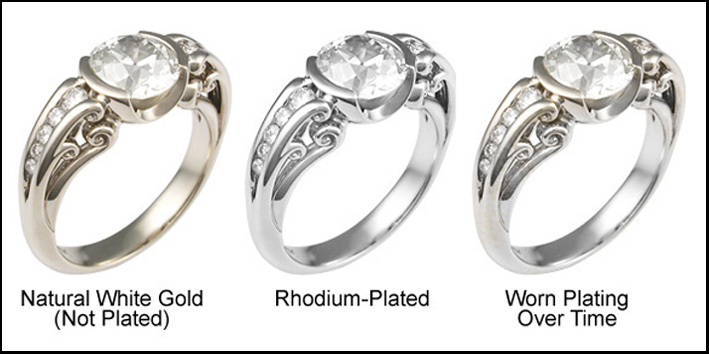
White gold over time: as the rhodium plating wears, the warmer tone underneath starts to show.
Karat Purity (14k, 18k, 24k)
Karat just tells you how much pure gold is in the mix. 24k is pure gold, 18k is 18 parts gold to 6 parts alloy, and 14k is 14 parts gold to 10 parts alloy. You'll sometimes see it stamped as a number instead: 585 means 14k (that's 58.5% gold) and 750 means 18k (75% gold). In the US, 10k is the lowest you can legally call gold, though you'll find lower abroad. For fine jewelry, 14k and 18k are the sweet spot, and you'll almost never see pure 24k in a ring with stones, it's just too soft to hold them safely.
Platinum
If gold is the classic, platinum is the heavyweight. It's naturally white, so a lot of people consider it the best white metal you can get, no coating required. It's also about three times rarer than gold, which is why it costs more, but you're getting a denser, purer metal (90 to 100% pure), so there's more actual precious metal on your finger per ounce. On the inside of the band you'll see it marked Plat, PT, or a number like 900, 950, or 995.
Platinum Purity and Durability
Because it's so pure, platinum is hypoallergenic, which is great news for sensitive skin. It's also built to last. The secret is something called metal memory, basically a metal's habit of slowly creeping back toward its original shape, which is what makes prongs gradually loosen and let go of a stone. Platinum barely has any, so it keeps a tight grip on your diamond. And when it does get scratched, it doesn't lose metal, it just shifts it around, so it can be smoothed back out. All of that adds up to a metal that can last up to ten times longer than the others.
Platinum vs White Gold
They look almost identical, so this question comes up a lot. The difference is under the surface: white gold gets its color from rhodium plating that wears off and needs redoing, while platinum is white all the way through and never needs it. Platinum is tougher and holds stones more securely, but it's pricier and heavier. White gold is lighter on the finger and on the wallet, as long as you don't mind the occasional touch-up. Honestly, both are gorgeous, and you can compare them in person across our engagement rings.
Palladium
Palladium is platinum's lighter, more budget-friendly relative. It's in the same family and shares that natural white color, but it weighs less and usually costs just a little more than gold, so it became popular as a way to get the platinum look without the platinum price. It feels a lot like gold on the hand and shrugs off scratches about as well. One heads-up: palladium is more reactive than gold or platinum, especially around chlorine, so treat it gently and never wear it in the pool. Like platinum, it's hypoallergenic (90, 95, or 100% pure), and you'll spot it stamped PD inside the band.
Palladium vs Platinum
They're close cousins, both naturally white and both kind to sensitive skin. The real differences are weight and price: palladium is noticeably lighter and easier on the budget. Just remember it doesn't love chlorine, so it's not the one to wear swimming.
Sterling Silver
Sterling silver is the budget-friendly option with the brightest white shine of the bunch. It's 92.5% pure silver mixed with 7.5% copper, nickel, and zinc, since pure silver on its own is way too soft to hold up. You'll see it stamped 925, which is just that 92.5% showing up on the band.
Silver Tarnish and Care
Silver is the only one of these metals that tarnishes, that dark film that shows up when silver reacts with stuff in the air. Don't worry, it wipes right off with a treated polishing cloth, and here's a nice bonus: the more you wear it, the slower it tarnishes, because the natural oils on your skin keep it buffed as you go. The one catch is that silver has no protective plating and contains nickel, so it's the most likely of these metals to irritate sensitive skin. For a ring you'll wear every single day for life, a lot of couples lean toward the toughness of gold or platinum in our wedding ring collection.
How to Choose the Right Metal for Your Ring
Every metal balances toughness, price, color, and upkeep a little differently. Here's a quick cheat sheet, then come talk it through with us so we can match it to your day-to-day life and budget.
| Metal | Hardness | Price Range | Hypoallergenic | Tarnish | Best For |
|---|---|---|---|---|---|
| Gold (14k/18k) | Soft to medium, scratches over time | Moderate | Not always (nickel alloys can react) | No | Classic looks, easy sizing and repair, color choice |
| Platinum | Dense and durable, displaces rather than loses metal | Highest | Yes | No | Secure stone setting and lifelong everyday wear |
| Palladium | Similar scratch resistance to gold, lighter than platinum | Slightly above gold | Yes | No | White metal on a budget; avoid chlorine and swimming |
| Sterling Silver | Soft even when alloyed | Lowest | No (highest reaction rate) | Yes | Brightest white luster, fashion and budget pieces |
Book a Metal Consultation in Chicago
Still not sure which metal is right for your ring? Come see us. Book a free consultation at our Chicago showroom and we'll put samples of each metal in your hands, talk through what fits your lifestyle and budget, and help you land on the perfect match.
Proudly Serving Customers Across Chicago
At Wedding Bands & Co , we provide custom jewelry design, engagement rings, and repair services to clients throughout Chicago. Highlighting our service areas helps customers quickly see that we’re local, accessible, and ready to help wherever you are in the city.
- River North
- Gold Coast
- Streeterville
- Magnificent Mile
- Chicago Loop
- Near North Side
- Old Town
- West Loop
- Lincoln Park
- Lakeview
- Wicker Park
- Bucktown
FAQ
What is the most durable metal for an engagement ring?
Platinum is the best choice for long term durability. It is denser than gold and does not lose metal when scratched, it simply displaces, which is why platinum prongs hold a diamond securely for decades. Fourteen karat gold is harder on the surface and resists scratching slightly better, but it wears thinner over time. For a ring worn every day, platinum offers the most security for the stone.
Is platinum better than white gold?
Neither is better, they are different trade offs. Platinum is naturally white, hypoallergenic, and never needs replating, but it costs more and develops a soft matte patina that some clients love and others prefer polished off. White gold is lighter and more affordable, but it is rhodium plated and needs replating roughly every one to two years to stay bright white. If you want low maintenance, choose platinum. If you want the white look at a lower price, choose white gold.
What is the difference between palladium and platinum?
Both are naturally white metals in the same family and neither requires plating. Palladium is significantly lighter on the hand and has historically been less expensive, though market prices for both metals move. Platinum is denser, which makes it the stronger option for holding diamonds, and it is easier to find for repair and resizing work. Palladium suits clients who want a white metal without the weight of platinum.
Does sterling silver tarnish?
Yes. Sterling silver is 92.5 percent silver alloyed with copper, and that copper reacts with sulfur in the air to create a dark surface tarnish. It is removable with a polishing cloth and regular wear actually helps keep it bright. Because of the tarnishing and the softness of the metal, we do not recommend sterling silver for engagement rings or daily wear wedding bands.
Which metal is best for people with metal allergies?
Platinum is the safest precious metal option. It is used at 95 percent purity with no nickel, so reactions are extremely rare. Palladium is also nickel free and a good alternative. Most metal allergies are actually nickel allergies, and nickel is commonly used in white gold alloys, so if you have reacted to jewelry in the past, platinum or a nickel free white gold alloy is the direction to go. Bring the piece that caused the reaction when you visit and we can identify the likely cause.
How do I care for my precious metal ring?
Soak it in warm water with a few drops of mild dish soap, brush gently behind the stones with a soft toothbrush, and rinse and dry it. Doing this every couple of weeks keeps the diamond bright, since buildup under the stone is what dulls the sparkle. Remove your ring for the gym, cleaning, gardening, and swimming pools. Have the prongs inspected once or twice a year, which we do at no charge for our clients at our Gold Coast studio at 43 E Oak Street.
Can you resize rings made of platinum and palladium?
Yes. Both metals can be sized up or down by our bench jeweler in house. Platinum requires higher heat and specialized platinum solder, so it takes more skill and slightly more time than sizing gold, and palladium has its own welding requirements. How far a ring can move depends on the design, since eternity bands and rings with stones set around the shank have limited range. Bring the ring in and we will tell you exactly what is possible before any work begins.
